The Math Behind Asteroid Impact Prediction - Will the Flat-o-Saurs Go Extinct?
65 million years ago, the dinosaurs were wiped out by an asteroid. The Flat-o-saurs are like the dinosaurs, but they live on a 2D planet called plane-et (which makes the math a bit cleaner in this article). Dr. Bi-ceratops, the 2D cousin of the 3D Triceratops, has set up an asteroid detection and monitoring system to try to avoid his cousin’s tragic fate.
Oh No! Dr. Bi-ceratops has detected an asteroid! In this paper, I’ll explain how Dr. Bi-ceratops’ detection and monitoring system works, and how he can calculate the probability of the newly discovered asteroid hitting plane-et.
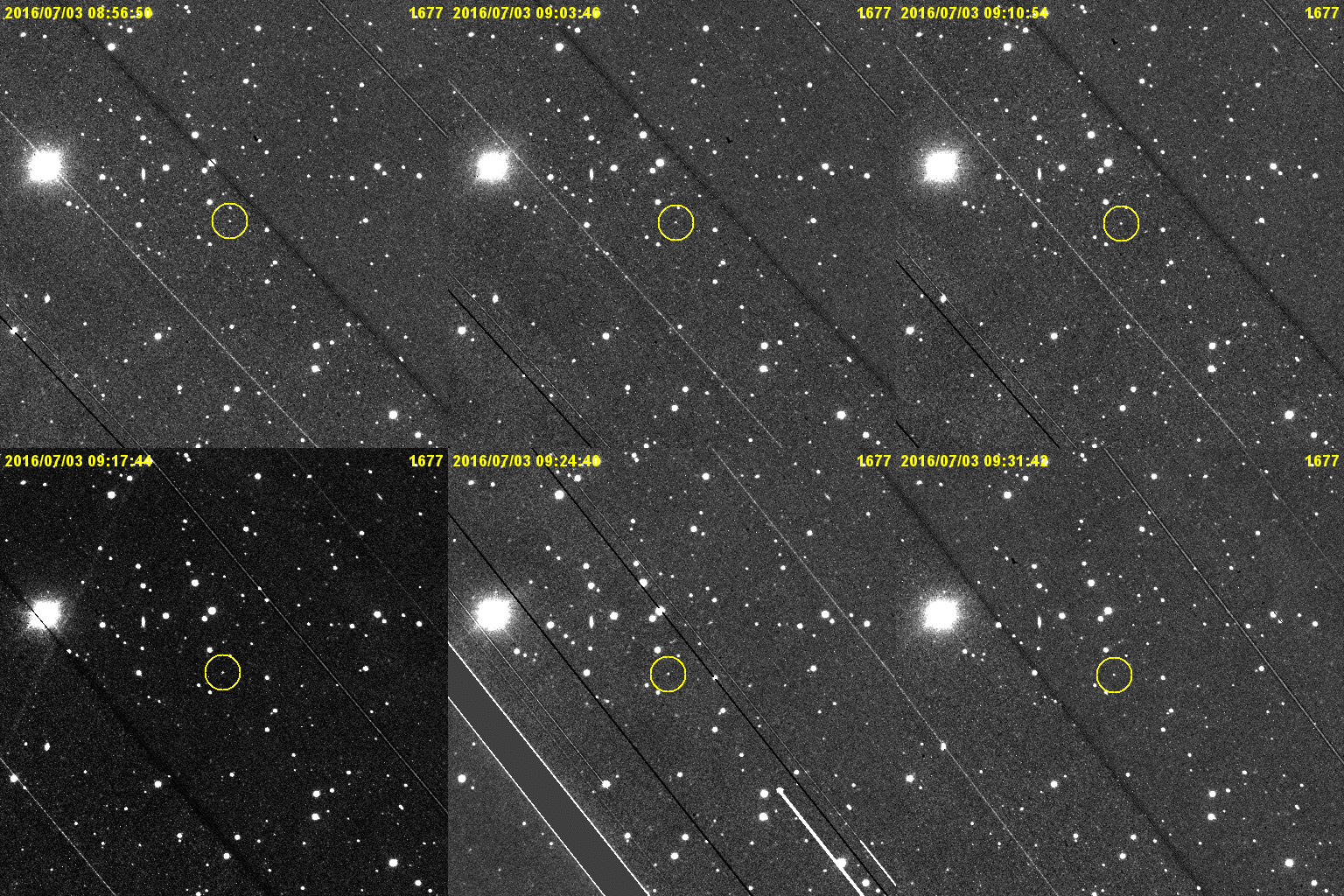
To find asteroids that might be a threat, Dr. Bi-ceratops has set up cameras pointed at the night sky. Sophisticated software analyzes the images from these cameras, and flags fast moving objects (which are likely to be asteroids).
Because the cameras only capture an image, they can calculate the angle of the asteroid relative to plane-et, but can’t (easily) find the distance of the asteroid to plane-et (the image has no depth information associated with it.)
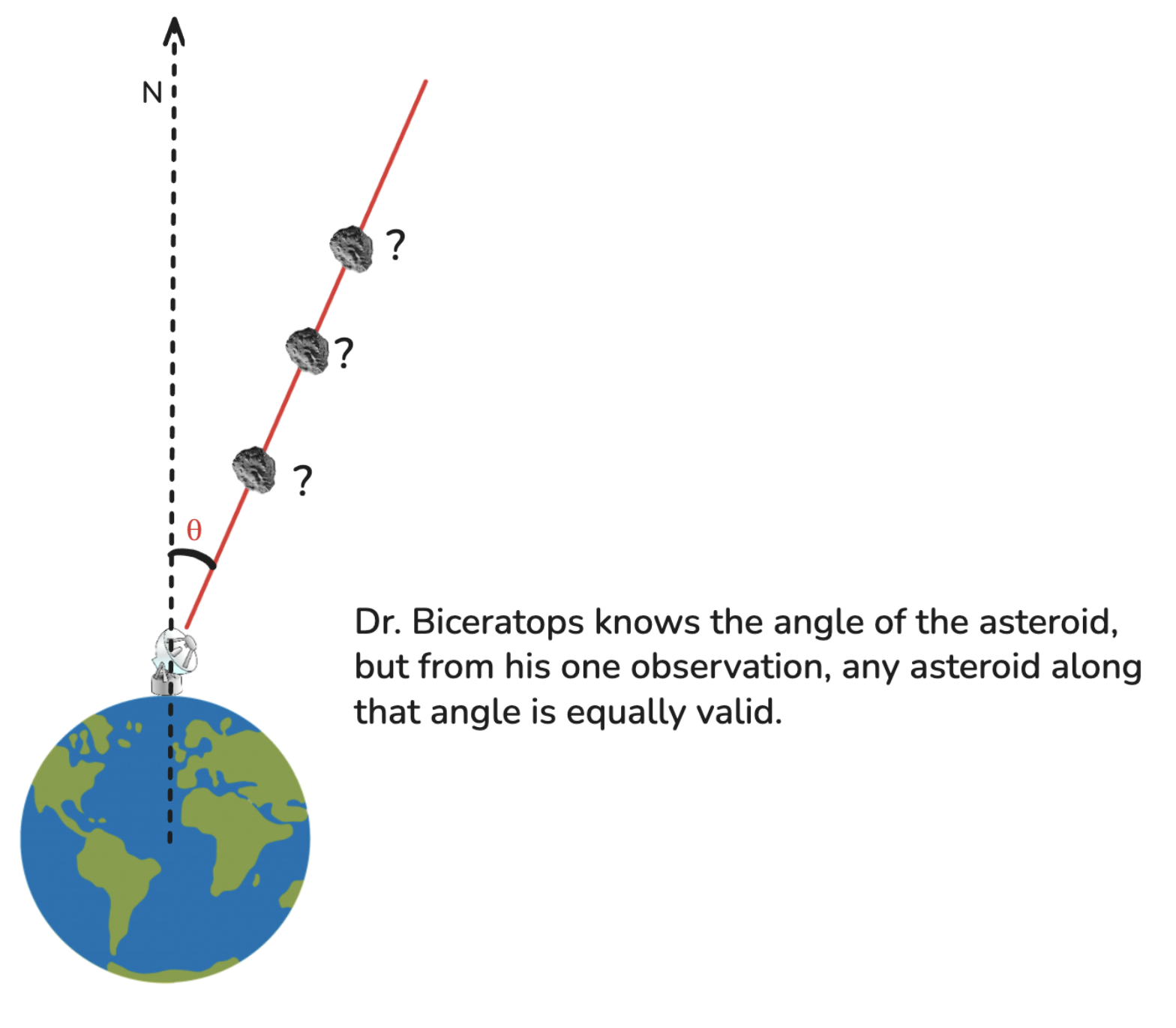
Before Dr. Bi-ceratops can predict whether the asteroid will hit plane-et, he needs more information about the asteroid. To fully describe an asteroid in 2-D space, Dr. Bi-ceratops needs its \(x\) and \(y\) coordinates, as well as its \(x\) and \(y\) velocities. From his one observation, all Dr. Bi-ceratops knows is \(\theta\). He knows that \(x\) and \(y\) are related to \(\theta\) by \(x = r \cos(\theta)\) and \(y = r \sin(\theta)\) where \(r\) is the distance from plane-et to the asteroid. Unfortunately, he still doesn’t know \(r\), \(v_x\), or \(v_y\).
Luckily, Dr. Bi-ceratops can make multiple observations!
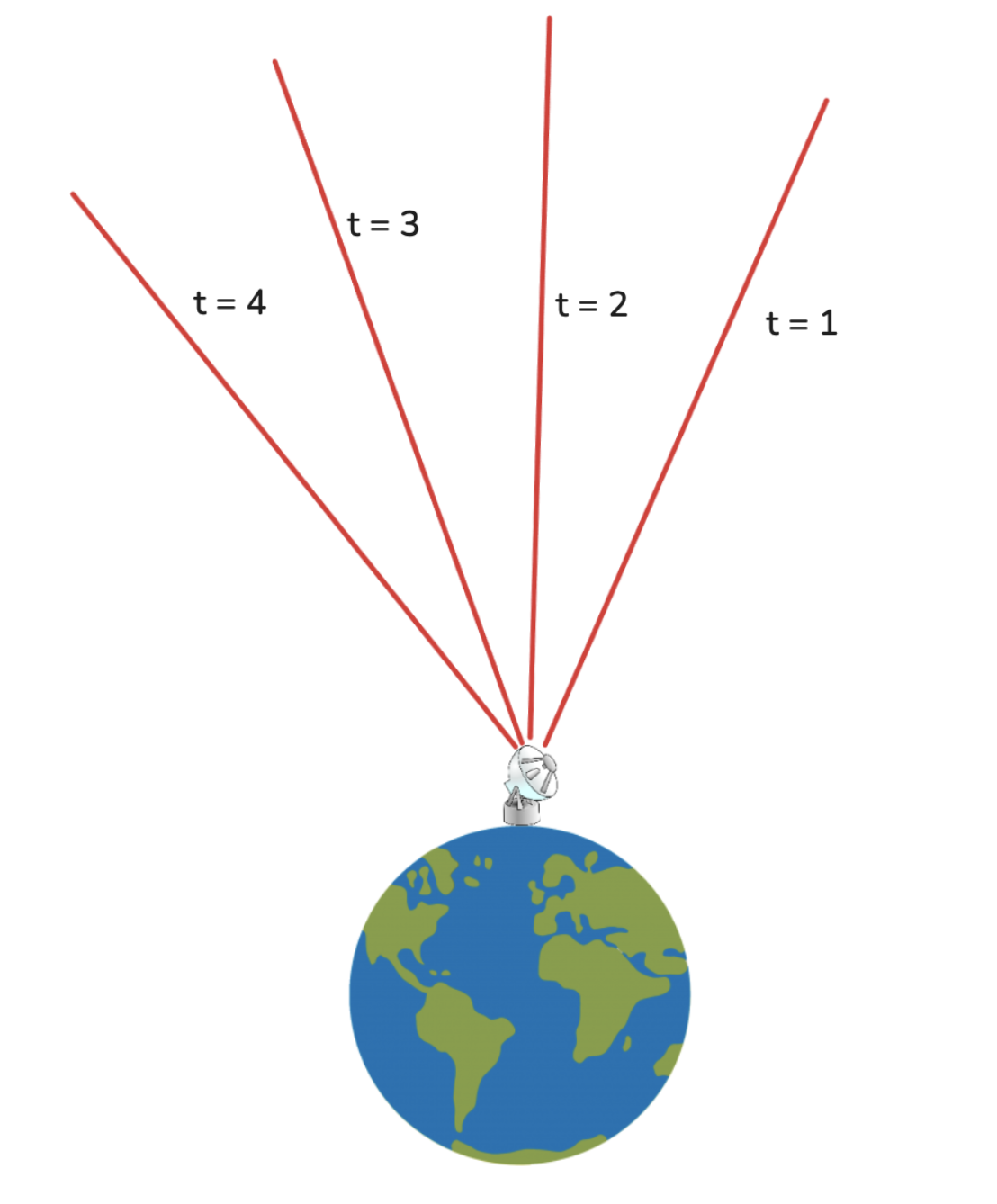
How can he use these multiple observations to help him find the unknown \(r, v_x\), and \(v_y\)? He can start with an estimate, and refine it until the estimated asteroid is consistent with every observation.
Let’s generate an asteroid with random \(r, v_x\), and \(v_y\) at \(t=0\), and simulate its motion according to Newton’s laws of motion.
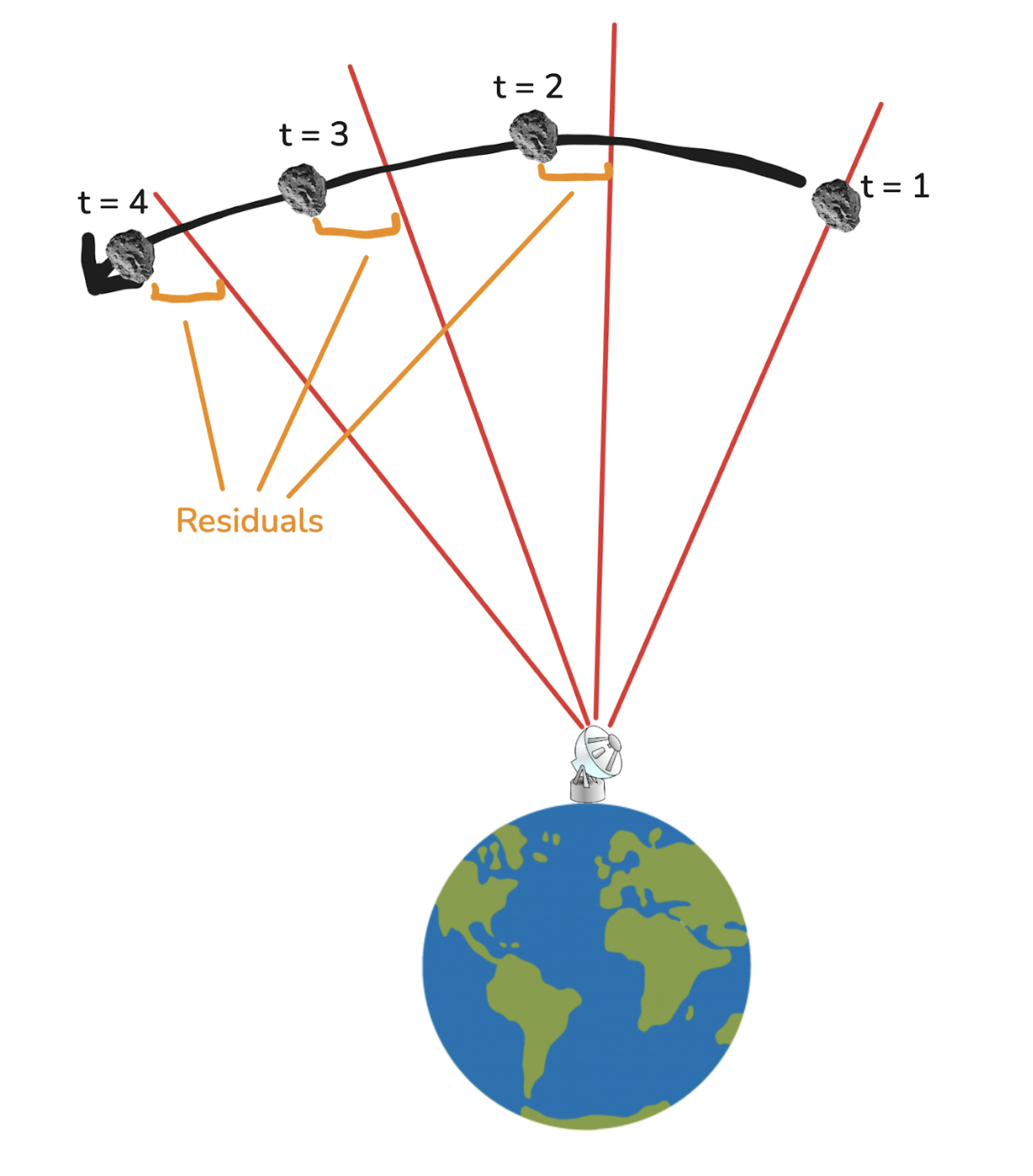
Hmm…this specific combination of \(r, v_x\), and \(v_y\) is not consistent with all the observations (it has large residuals). This means we probably haven’t found the values that best characterize the asteroid. However, if we find some combination of \(r, v_x\), and \(v_y\) at \(t=0\) that has small residuals, we’ll know we’ve found a good characterization of the asteroid.
Formally, we want to find the combination of \(r_{0}, v_{x_0}, v_{y_0}\) which when propagated forward in time using Newton’s laws of motion, minimize the weighted squared residuals relative to all observations.
Let’s define the following cost function Q:
\(Q=\hat{e}^TW\hat{e}\) for the residual vector \(\hat{e}=[e_0, e_1, ..., e_i, ... e_n]^T\), where \(e_i\) is the residual for observation \(i\).
As you can see, \(Q\) is a quadratic function of the residuals, although the form is a bit funky because $e$ is a vector. \(W\) is a weighting matrix, since some residuals may be less important than others to minimize. If all residuals are weighted the same, \(W\) would be the identity matrix.
So, Dr. Bi-ceratops needs to find the initial state of the asteroid which when propagated forward in time, minimizes \(Q\). How can \(Q\) be minimized? Harkening back to Calculus 101, Dr. Bi-ceratops vaguely remembers that a minima of a function occurs when its derivative (or in this case, gradient) is 0. P.S.: Typically, we wouldn’t know if the critical point was a min or max, but it turns out this cost function is highly convex in practice.
Let’s define the initial state of the asteroid as \(X_0\), where \(X_0\) = \([r_0, v_{x_0}, v_{y_0}]^T\). Note that \(X\) is the entire characterization of the asteroid, not just its \(x\) coordinate.
Formally, we need to find the value of \(X_0\) where \(\frac{\delta Q}{\delta x_0}=0\). To do this, we’ll start with an initial random (and probably bad) estimate of \(X_0\). Then, we’ll refine \(X_0\) by repeatedly changing it by some small \(\delta x\) until we’ve found the \(X_0\) where \(\frac{\delta Q}{\delta X_0}=0\).
Now, how do we find the right \(\delta x\) to change \(X_0\) by? Let’s examine what happens to the residuals when we change \(X_0\) by some small \(\delta x\). We assume \(e(X_0)\) is locally linear (remember, \(e\) represents our residuals). Then, \(e(X_0+\delta x)\approx e(X_0) + B\delta x\), where \(B\) is the Jacobian \(\frac{\delta Q}{\delta x_0}\). If this is a bit confuzzling, scroll down and Dr. Bi-ceratops will explain it better.
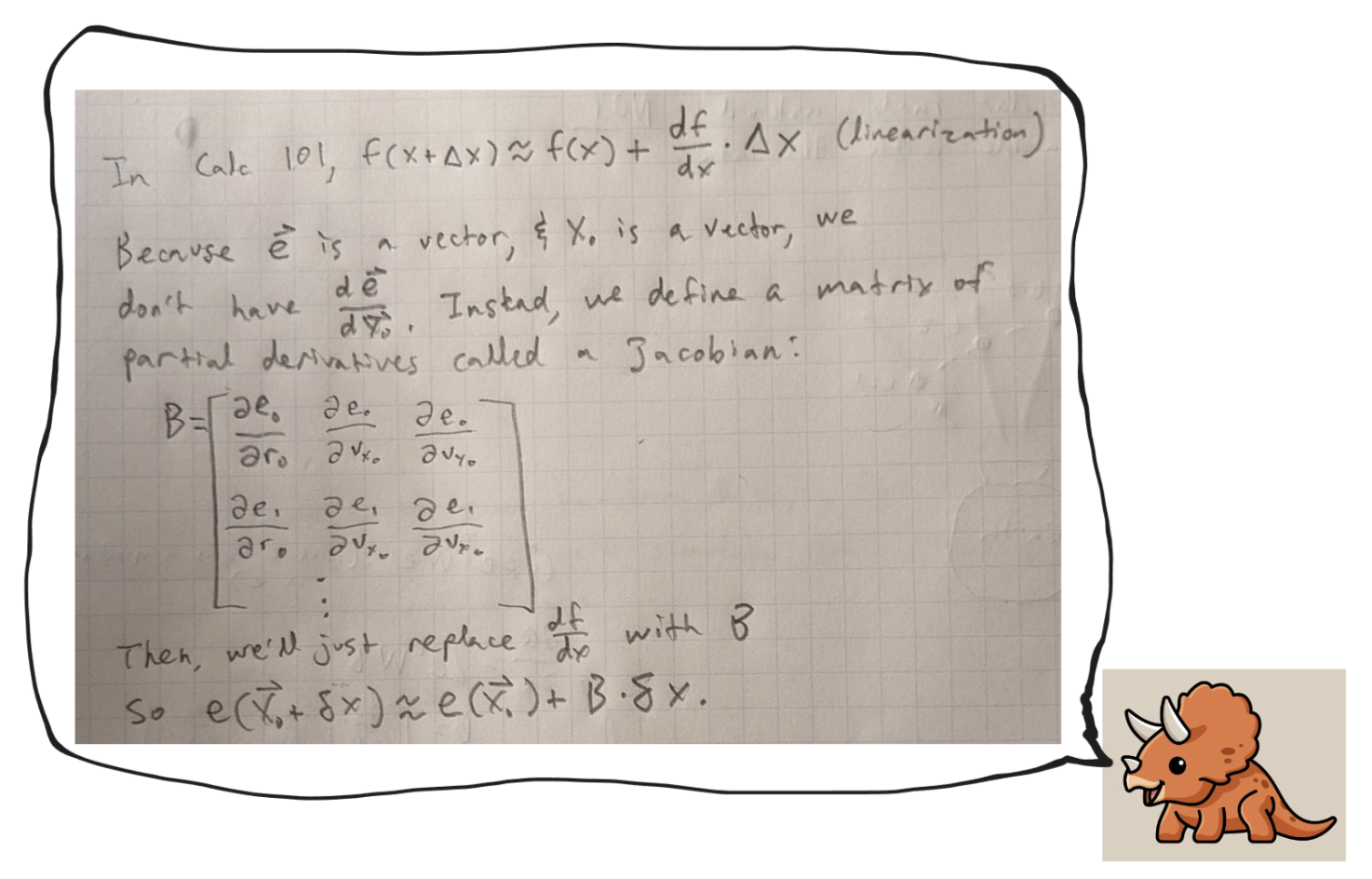
This in turn means that \(Q(X_0 + \delta x)=e(X_0+\delta x)^TWe(X_0+\delta x)\)
\(= e^TWe + 2\delta x^TB^TWe + \delta x^TB^TWB\delta x\) after expansion.
Whew! That expansion took me quite a while. But it was worth it, because if you look closely at the expanded expression, we see that the change in \(Q\) with respect to a small change in \(X_0\) is:
\[2B^TWe + B^TWB\delta x\]Wait a second! A small change in \(Q\) with respect to a small change in \(X_0\)? That’s \(\frac{\delta Q}{\delta X_0}\)!
We need that to be 0, so we try:
\[2B^TWe + B^TWB\delta x = 0\]which rearranges to:
\[\delta x = -C^{-1}B^TWe\]where \(C = B^TWB\)
Note that \(C\) is also the second-order partial derivatives of Q (C is the Hessian of Q).
So it turns out that:
\[\delta x = -C^{-1}B^TWe\]This means that by updating \(X_0\) by \(-C^1B^TWe\) repeatedly, we’ll eventually refine our characterization of the asteroid into something that’s compatible with all observations!
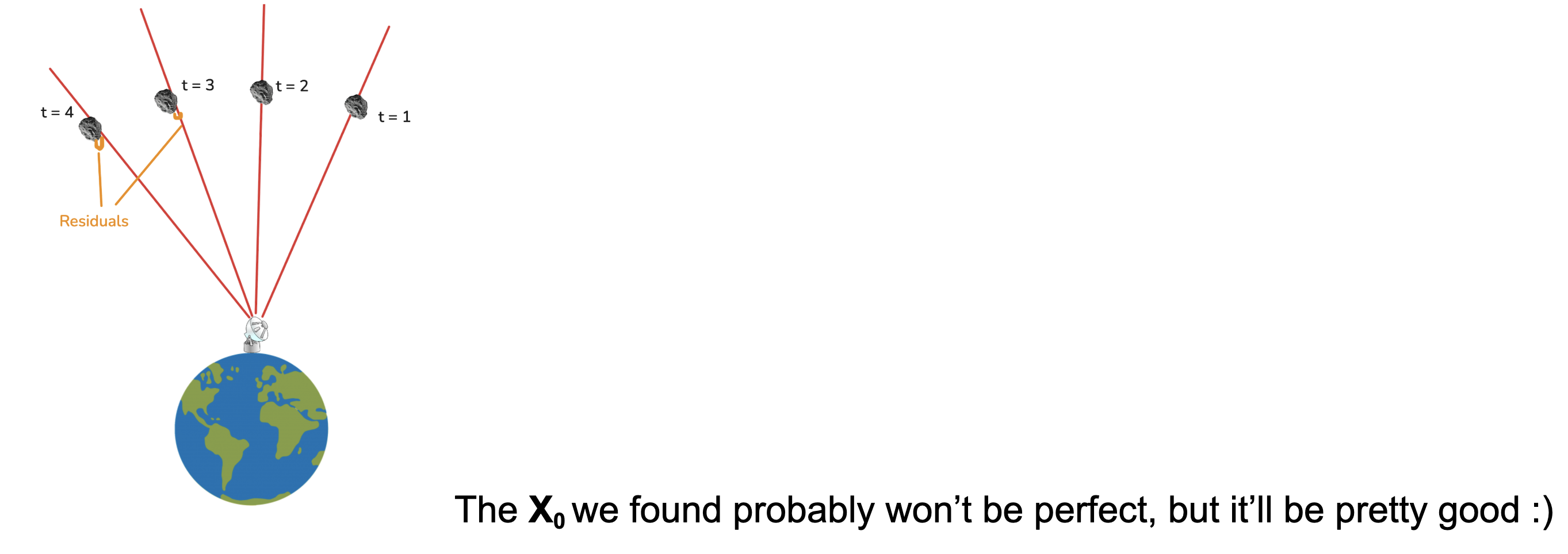
So we’ve found a \(X_0\) that is the best characterization of the asteroid. However, because there’s some uncertainty in our measurements, and because the \(X_0\) we found still doesn’t lead to a path that fits perfectly with all observations,\(X_0\) should actually be represented as a multivariate probability distribution centered at the best singular \(X_0\) value we found. From now on, I’ll use \(X_0\) to represent the probability distribution, and \(X_{best}\) to represent the singular value we found previously.
Let’s assume \(X_0\) is Gaussian. A multivariate Gaussian takes the form:
 $\Sigma$ represents the covariance matrix of the distribution.
We already know \(\mu\) is \(X_{best}\), so what we need to find now is the covariance \(\Sigma\).
Intuitively, some \(X\) ~ \(X_0\) with a high cost (\(Q\)) has a lower probability than a \(X\) with a low cost, since it is less compatible with the observations.
We’ll formalize this idea as \(Q(X)\propto-\log(P(X)) + C\) for some constant \(C\). This means that a \(X\) with a high cost has a probability approaching 0, and a \(X\) with a low cost has a probability approaching 1.
Rearranging, \(P(X)\propto e^{-Q(X)}\).
After some further calculation, we can use this to extract a covariate matrix for \(X_0\).
Then, we’ll be able to get a distribution for something like \((v_{x_0}, v_{y_0})\) that looks like the following:
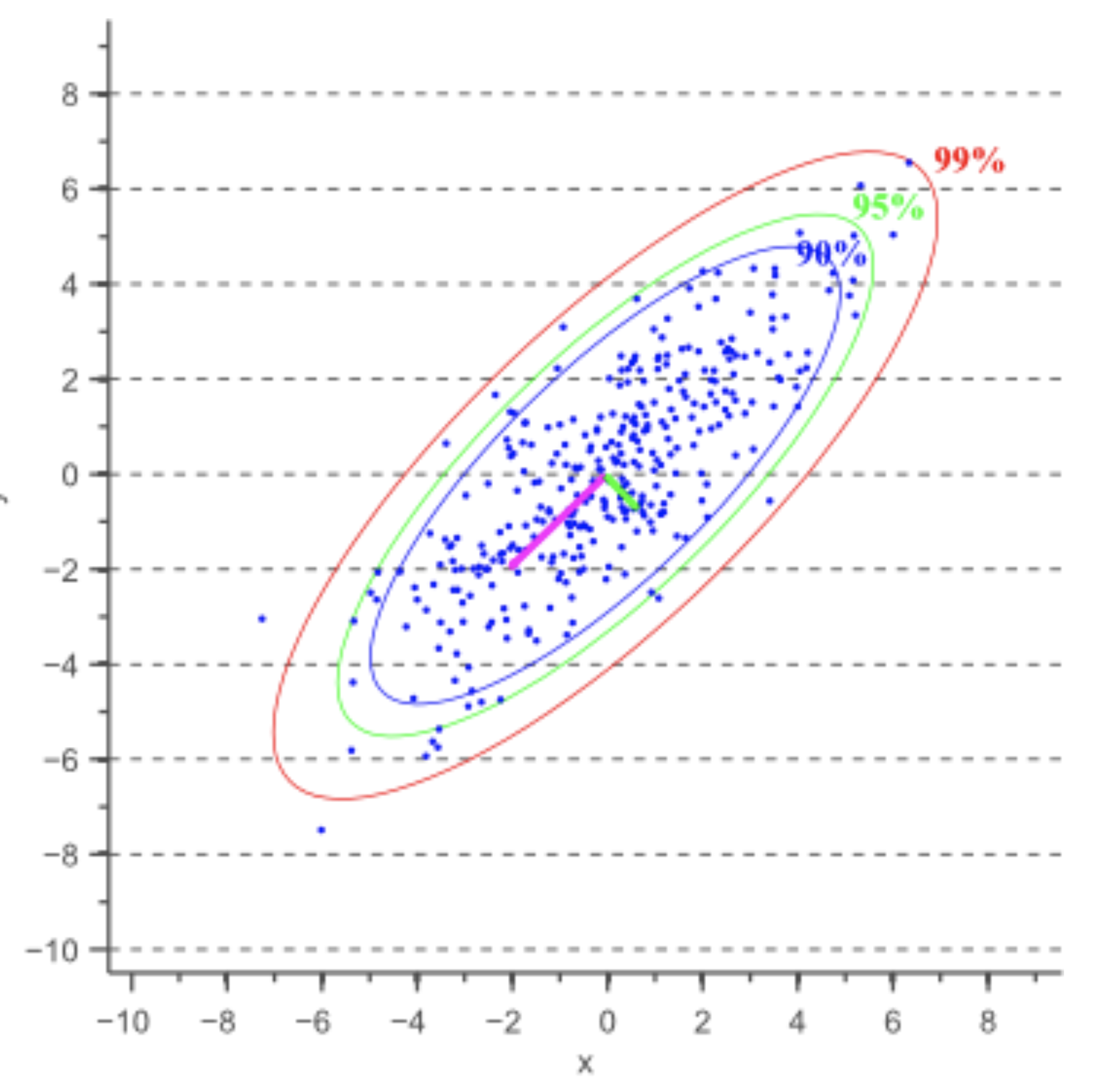
If Dr. Bi-ceratops were a 3 dimensional creature instead of a 2 dimensional creature, he’d be able to see that the actual distribution looks like a 3D ellipsoid describing the uncertainty in \(r_0, v_{x_0}\), and \(v_{y_0}\)!
Now that the asteroid is pinpointed, it’s pretty easy*** to calculate the probability of impact with plane-et. Just sample a bunch of asteroids from the probability distribution, simulate their paths using Newton’s laws of motion, and check if they collide with plane-et, and we’re done!

* What I described for calculating probabilities is really slow cause you have to sample a lot of asteroids - there are much better and faster ways that I would write about but the flat-o-saurs are after me and I don’t have tim-